
What Was Left Behind: On Katrina, Genocide, and Grief That Still Lives in the Walls
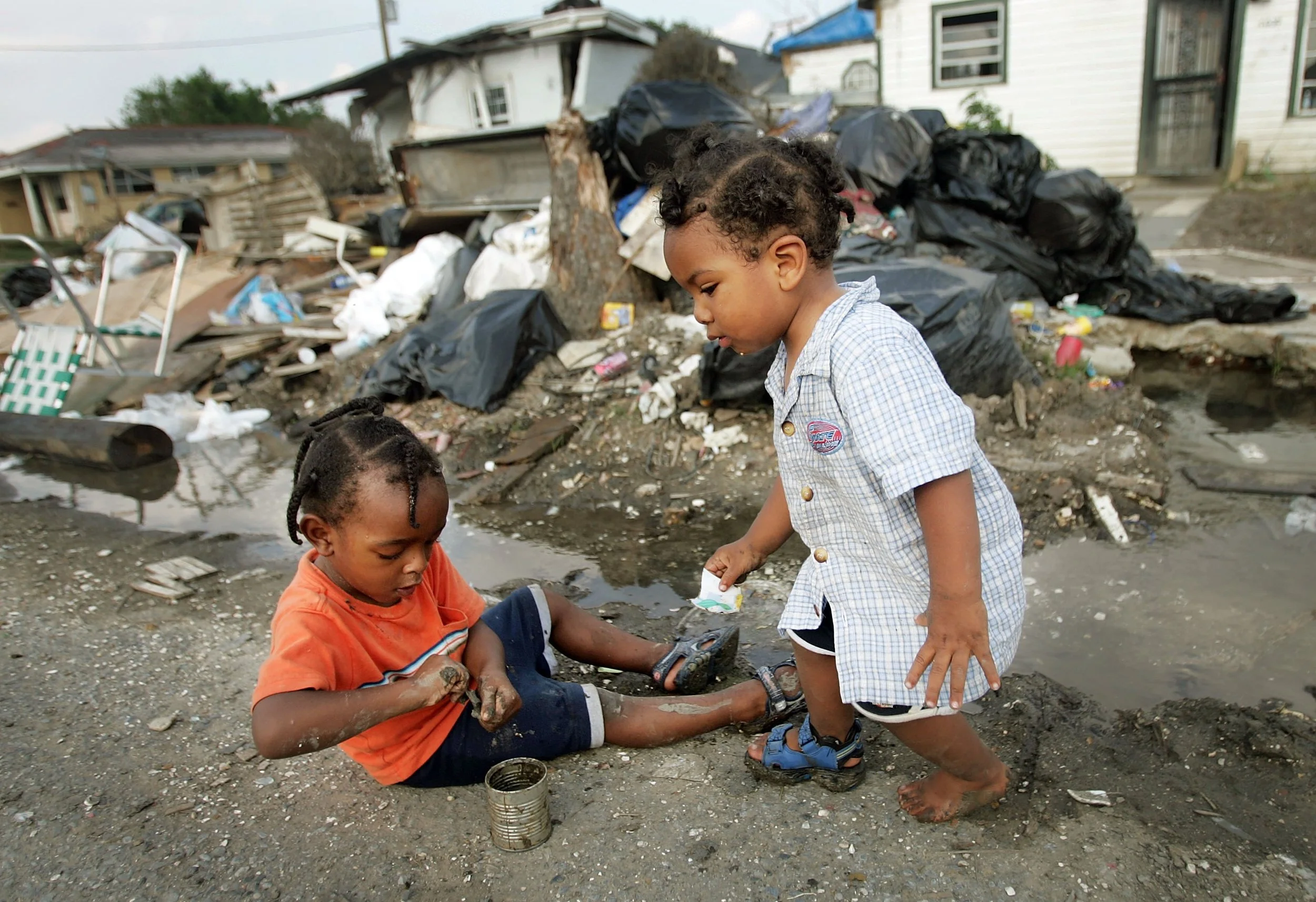
All photo credits to CNN.com
Next month marks 20 years since Hurricane Katrina made landfall. I don’t like to use the word Anniversary and Hurricane Katrina in the same sentence because to me, it romanticizes horror, trauma, and pain. This week, I watched Hurricane Katrina: Race Against Time—a new five-part docuseries directed by Traci A. Curry and produced by Ryan and Zinzi Coogler (Thank you for this body of work.)
On August 29, 2005, Katrina made landfall in the beloved city. I was 16 years old at the time. Watching the documentary felt like reliving those days all over again. I recalled what it felt like back then, sitting in front of the television for hours, praying and waiting, but never fully understanding the extent of the pain and destruction. While watching the documentary, I didn’t expect to cry as much as I did. I didn’t expect to feel so enraged, but I was. It felt like watching my people die all over again, like being reminded of how disposable Black life has always been in this country. I felt angry. I felt helpless. And most of all, I felt an immense amount of grief for the lives we lost, the ones we couldn’t save, and the parts of us that were never allowed to fully return.
One of the deepest problems in this country is the widespread lack of empathy, especially when it comes to poor Black communities or any group whose struggles don’t directly touch others’ emotional or economic realities. Too many people in America are desensitized to suffering unless it mirrors their own. There’s a collective disconnection, a moral numbness that shows up in how we dismiss, delay, or ignore the pain of the most vulnerable. The urgency to care only seems to surface when people feel personally affected. And that selective compassion is part of the problem.
Hurricane Katrina: Race Against Time offers a gutwrenching reexamination of one of America’s greatest domestic tragedies, twenty years after the levees broke and the nation looked away. The series trades romanticized remembrance for sobering truth, using archival footage, survivor testimony, and investigative clarity to expose the layers of failure that led to the devastation of New Orleans.
Rather than frame Katrina as a singular moment, Race Against Time maps a timeline of systemic collapse, one where rescue delays, government apathy, and racial bias collided to turn a natural disaster into a human rights crisis. The series refuses to sanitize or simplify what happened. Instead, it centers the voices of residents who lived through it. These are stories we should never stop telling because they’re not just stories about what was lost; they’re a chronicle of what was taken, who paid the cost, and why it still matters now more than ever.
My father grew up in the Saint Bernard projects. His side of the family is deeply rooted in New Orleans. When I was a teenager, I used to dream of going back there with him, meeting relatives I’d never met, walking the streets he once knew, exploring the parts of his hometown that might help bridge the gap between my inherited longing and the unexplainable connection I’ve always felt to the city.
He would share stories from his youth, some vivid, some buried in pain. And even when he didn’t fully articulate it, I could feel that the city was rooted in both beauty and pain. Still, it was home. It was the only home many of my family ever knew. When Katrina hit, it wasn’t just structures that were lost. It was memory. The family I had never met, the neighborhoods I had only heard about, the streets he walked as a boy were all part of the city swallowed by that storm.
Katrina isn’t just a story I watched unfold on television. It’s a wound, one that shaped my understanding of family, legacy, and the spaces I never got to return to. My father wasn’t living in New Orleans during the storm, but the grief still lives in us. In our silence. In our blood. In the rage we rarely name but deeply carry.
What happened in New Orleans wasn’t just about a hurricane. It was about abandonment. The carelessness of city officials and the United States government forced an entire city to endure the storm's aftermath. It was about how quickly this country decided that certain lives, Black lives, poor lives, weren’t worth saving. Over 1,800 people died, but numbers don’t tell the truth. The truth is that elders drowned in their wheelchairs. Babies were dehydrated in the heat. People died on their rooftops, and helicopters flew right over them to other locations. They were on their rooftops waving for help that never came. And what’s worse? They were blamed for it.
The media vilified the victims. Many of them hadn’t eaten in days. They had no dry clothes. No idea where their loved ones were. No phones. No way out. Just hunger, exhaustion, grief, and survival instinct. And for that, they were criminalized. Black families wading through waist-deep waters, catching infections while looking for food, clothes, and dry shoes, were labeled as looters. Residents in other cities killed the innocent who went into stores to take food or necessities that they rightfully deserved and needed to survive, while white survivors doing the same were called desperate. They were walking barefoot through toxic, floodwaters. Residents recalled how floodwaters housed alligators, crocodiles, and potentially sharks. Some infants and toddlers who were separated from their families had drowned and were floating in the waters, along with adults and pets who had also drowned.
We have to talk about the way people were dehumanized on the news. About the photos that showed Black children crying, clinging to their mothers, standing on roofs with the word “HELP” painted beneath them, and how those images were used to stir pity without ever delivering justice. We need to never forget that these families were forced into public spaces like the Convention Center and Superdome and left to die in the heat without water or food. They slept on floors and fields soaked in storm water, and rocks were used as resting places. People crossed over and walked by dead bodies for days while waiting for rescue. We have to name the trauma of being both abandoned and blamed.
There’s another truth people don’t like to touch, and it’s the likelihood that the levees didn’t just break. Residents recall hearing explosions—loud booms near the levees, moments before the flooding overtook their neighborhoods. These aren’t conspiracy theories. These are eyewitness accounts. These are people who watched water rise faster than should’ve been possible. Who knew what they heard. Who knew what they felt. This wasn’t a passive failure; it was an active breach. And when we talk about accountability, we cannot ignore that.
To call it genocide may feel uncomfortable for some, but what else do you call it when a government allows thousands of its own citizens, primarily Black, to die, and then displaces the rest under the guise of “rebuilding”? Entire neighborhoods were erased. Public housing demolished. Communities scattered across the country, never to return. I remember victims of the Katrina aftermath moving to California and attending school with me. These families were forcibly relocated to cities and communities outside their own, and many were never allowed to return. The culture of the city changed forever, and not by accident. What wasn’t drowned was forcibly removed.
There’s a spiritual heaviness in New Orleans that can’t be explained away by architecture or weather. It’s the presence of the dead. The unrest of thousands who never got to leave. Some died angry. Some died calling out for their mothers. Some died with no one there to bear witness. They died hot, starved, and afraid, and their spirits linger. The city remembers, even if the government won’t.
And for those of us with ties to that land, that memory is sacred. Many families still carry it. The grief, the loss, the disbelief of it all. Some relatives never came home. Some never got answers. Some never got closure. And some, like my father, carry the knowing in silence. Because what do you say when your country lets your people die?
When you’re poor in America, you are never truly free. You live at the mercy of a system designed to oppress, exploit, and erase you. It doesn’t just overlook you, it belittles you, criminalizes your survival, and in far too many cases, leaves you to die in the shadow of its greed. Katrina wasn’t just about a storm. It was about whose lives are worth saving. It was about whose suffering gets softened in the retelling and whose gets erased entirely. It was about racism, policy, power, and the cost of being Black in America during a crisis. The world watched Black people beg for help and then blamed them for not being able to help themselves.
So no, we won’t forget. We won’t move on because this country will NEVER be able to repay the people of New Orleans, and Black people in general, for all that they’ve taken from us.
We listen to the stories, especially the ones that were ignored. We name the trauma. We honor the dead. And we remind the world: some things weren’t lost; they were stolen. And some wounds don’t close; they continue to ache because healing was never made possible. Too many were robbed of that chance.